
Table of contents
Most people get SEO wrong.
They treat it like a small task. They hand it off to a freelancer, add a few keywords to a blog post, and forget about it. Then three months later they ask why it did not work, and they move the money back to ads.
That is not how SEO works. And that is not what SEO is for.
SEO is not something you add on at the last minute. It is part of the base you build your whole business on. When you do it right, it becomes one of the strongest parts of your growth plan. It is a channel that keeps growing, even after you stop spending money on it. Organic search still brings in about 53% of all website traffic, more than any other channel. And on average, every $1 spent on SEO brings back about $7.48. That is almost double what paid ads return. This is not a small detail. This is a channel most small businesses do not spend enough time on, simply because it does not pay off in week one.
In this post, I want to show you why SEO deserves a real place in your growth plan. I will walk through what it actually takes to do it right. Then I will show you real numbers from what we have built at Awesome over the last six months, including where we now rank for words like mouth tape, nasal strips, and nasal dilator. I will also show you how we actually pick our keywords, step by step.
Why SEO should be part of your plan from day one
Most growth plans lean on channels you have to keep paying for. Paid social. Paid search. Influencers. The moment you turn off the budget, the traffic stops that same day. SEO works in a different way. It is slower to start, but it keeps paying you back. One good page can keep bringing in traffic and sales for years, without much extra work.
Here is why SEO belongs at the center of your plan, not off to the side.
It gets cheaper the longer you do it
Once a page ranks well, each new visitor costs you almost nothing. Compare that to ads, where the price per click keeps climbing as more people bid on the same words.
It reaches people who are already looking for you
Ads and social posts try to create interest. SEO shows up when someone is already searching, for your product, for a problem you solve, or for how you compare to someone else. That is about as close as you can get to reaching someone who is ready to buy.
It builds something that lasts
Every page you write, every product page you improve, every link back to your site adds to something that keeps working for you. Two years from now, that work is still paying off. A paid ad from two years ago is gone.
None of this happens on its own, though. It happens because the site was built the right way first, before anyone worried about ranking for a single word.
The boring work nobody wants to do first
Most SEO plans fail, not because there is not enough content, but because there is no strong base underneath it. Before you chase rankings, you need a few things in place.
A site that is easy to find and easy to read
If search engines cannot easily find your pages and understand what they are about, nothing else matters. This means a clean layout, simple links between pages, a fast loading site, and clear categories.
Content that answers the real question, not just the keyword
A keyword is not the goal. It is a clue about what someone is actually asking. If your page does not answer that question the way the person expects, ranking well will not help you much anyway.
Real depth on your subject
Search engines now favor sites that go deep on a topic, not just one page here and there. That means writing a full set of pages around each thing you sell, not one blog post and done.
Trust built up over time
New websites get treated with caution at first. Search engines wait to see steady, honest signals before they trust a new site enough to rank it for harder, more competitive words.
Patience, and a lot of it
Most SEO work takes about 3 to 6 months before you see steady movement, and 6 to 12 months before you see a real return, sometimes longer if your market is crowded. If anyone tells you they can get you ranked overnight, they are either wrong or trying to sell you something.
This is the part of SEO nobody likes talking about. It is also the only part that makes everything after it actually work.
The other thing nobody talks about enough: you need someone inside the company who actually understands SEO and owns it. Not a freelancer you check in with every few weeks. Someone who lives with the site, watches the data, and pushes the boring work forward every single week. A huge shout out to Kaustubh Saini, who leads SEO for us and is genuinely one of the best in the game. Most of what you are about to see in the numbers is a direct result of his work.
What that looked like for Awesome
We started taking this seriously in January this year. Instead of chasing rankings right away, we spent the first stretch of the year building the base. We cleaned up the Awesome site. We fixed technical problems. We wrote real, deep content around our main products, mouth tape, nasal strips, and nasal dilators. And we worked on earning the kind of trust signals that tell search engines a site is worth ranking.
The trust and traffic climb
Here is what that looked like in the numbers. Our trust score with search engines barely moved in January and February. Then it jumped in March and April as the base work started to pay off, and it has held steady since. Our visitors from search followed close behind, flat for months, then climbing fast once that trust kicked in.
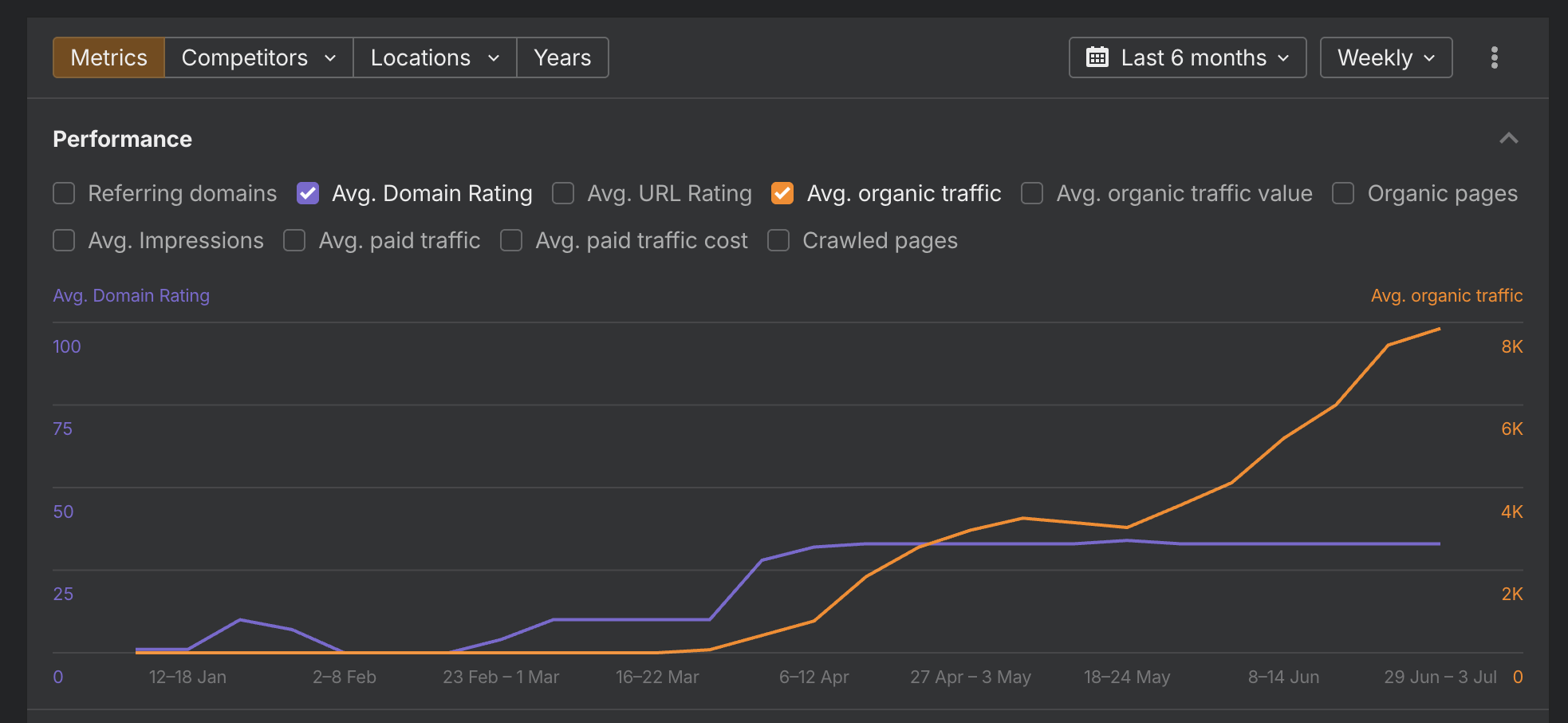
We started the year with a trust score of 6 and almost no visitors from search. By July, the trust score had settled at 33, and our monthly visitors from search had climbed to about 7,800, with most of that growth landing in the last two months.
That jump did not happen by luck. It happened because we crossed the point where search engines finally trusted the site enough to rank us for harder words.
Where we rank right now
Now, heading into the third quarter of the year, here is where we stand on our main product words in our biggest market.
| Word | Our rank | Searches / mo | Difficulty (1–100) |
|---|---|---|---|
| mouth tape | #1 | 5,800 | 6 |
| mouth tape for sleeping | #1 | 4,600 | 18 |
| nasal strip | #5 | 1,500 | 8 |
| nose tape | #5 | 1,300 | 8 |
| nasal strips | #12 | 2,000 | 9 |
| nasal dilator | #12 | 900 | 10 |
We are the number one result for mouth tape and mouth tape for sleeping. We are also moving up toward the first page for nasal strips and nasal dilator. Across the whole site, we now rank for 347 words in our main market, and 132 of those are already in the top 3 spots.
I want to be honest here, because overclaiming is exactly the trap I am warning you about in this post. Some of these words we already own. Others we are still climbing toward. That is the real story with SEO. It is a mix of wins at different stages, not one big switch that flips overnight. But the pattern, and the fact that we got here without leaning on paid traffic, is the whole point.
Think of the search page as real estate
Here is something most people never stop to think about. A search results page is not one single prize that you either win or lose. It is a whole piece of land, and you can own more than one spot on it at the same time.
Think about everything that can show up when someone searches one word. There is the organic list, the results that show up because a page earned that spot for free. There are shopping listings, the little boxes with a photo and a price. There are paid ads sitting right at the top. And there are other websites entirely, like Amazon, that might sell your product too and show up for that same search.
Every one of those spots is a chance for someone to see your name. And you do not have to pick just one.
Here is what it looks like when someone in India searches mouth tape on Google right now.
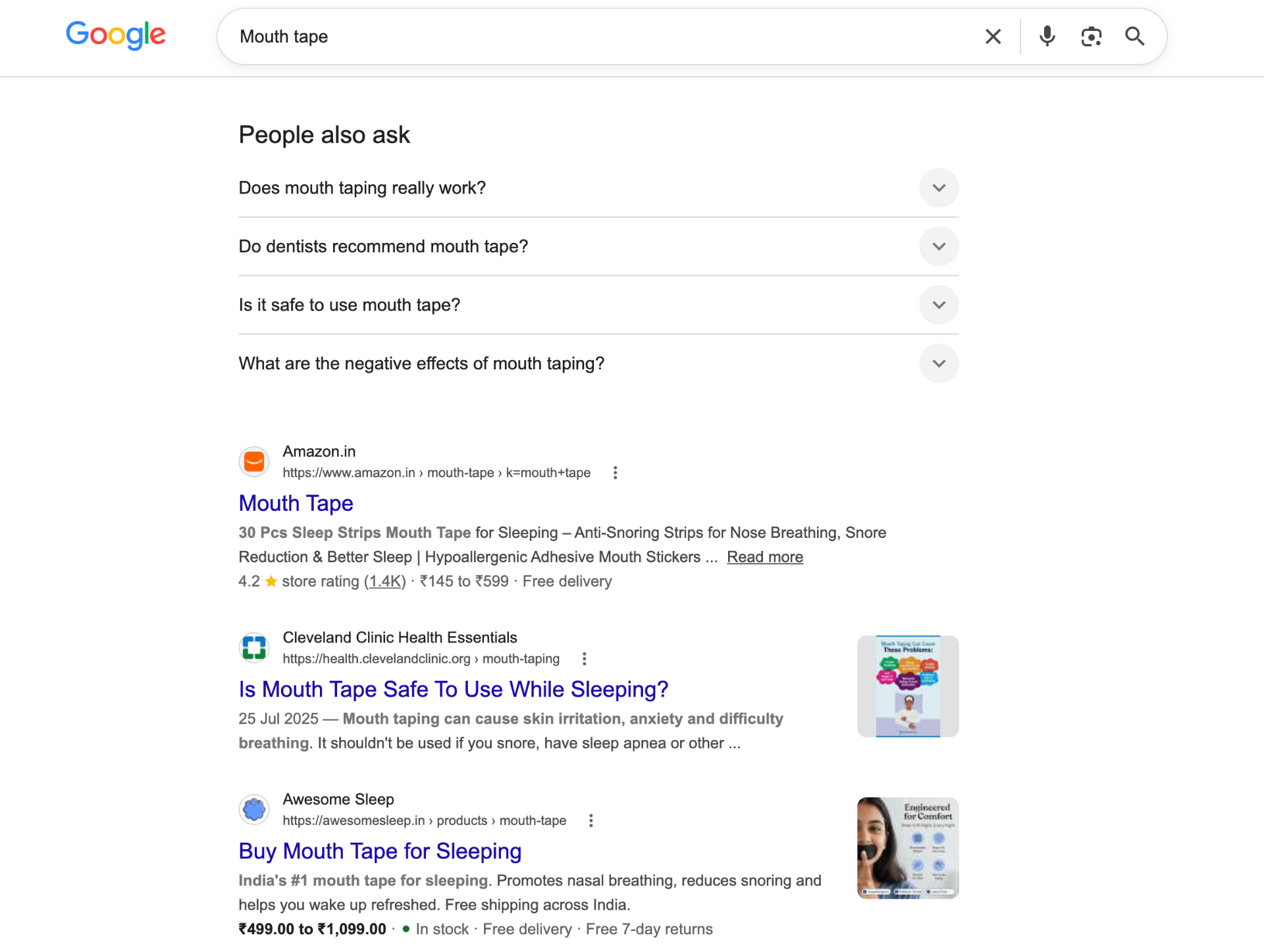
That is only part of the picture, though. For that same word, we also run a paid ad. We also run a shopping listing with a photo and a price. And since we sell on Amazon too, our product shows up there as well. Add it all up, and our name can show up four or five separate times on one single search page.
Why does that matter so much? Think about what it does inside someone's head. If a person searches something and sees the same name show up again and again, in different spots and different formats, they start to trust it without even thinking about it. It stops feeling like an ad. It starts to feel like the whole page agrees that this is the answer. That feeling is worth more than any single ranking on its own.
This is why you should never plan your SEO all by itself, off in its own little corner. Think of the whole search page as space you are trying to hold as much of as you honestly can. Your organic result earns you a spot that never disappears, even when you stop spending money. Ads and shopping listings fill in the rest of the page while that organic trust keeps building underneath. Put them together, and it looks like your brand owns the answer to that search. Because at that point, you actually do.
How we actually pick our keywords
This is the part most people rush through or skip, and it is where a lot of SEO plans go wrong from the start. Real keyword research is not picking the word with the highest number of searches and writing a page for it. It means weighing three things together, how many people search it, how hard it is to rank for, and what that person actually wants when they search it.
Picking a word you can actually win
Here is an easy example from our own product line. The word nose strips gets about 27,000 searches a month, five times more than mouth tape. But it is much harder to rank for. Mouth tape gets 5,800 searches a month and is much easier to rank for. For a site that is still growing, mouth tape is the smarter target. You do not always chase the biggest number. You chase the word you can actually win, especially early on while you are still building trust.
This is also why how hard a word is to rank for matters just as much as how many people search it. A popular word with weak competition can be easier to win than a smaller word with five strong, well established sites already sitting on page one. Good keyword research is not about finding the biggest opportunity on paper. It is about finding the one you can realistically win, based on where your own site stands right now.
Writing for every stage of the search
This is also why we do not just target one big word at a time. We look at the whole group of related searches around a topic, and we write for every stage of that journey.
- People just starting to look into it search things like: does mouth tape work, is mouth tape safe, how to use nose strips.
- People comparing their options search things like: mouth tape benefits, mouth tape for snoring, nasal strips for breathing.
- People ready to buy search things like: mouth tape for sleeping, best mouth tape for sleeping, nasal dilator for snoring.
Each of these searches is a different person at a different point in their decision. Someone searching is mouth tape safe is not ready to buy yet. They want a clear, honest answer, not a sales pitch. Someone searching mouth tape for sleeping is much closer to buying. If you show up for both, you catch people early and keep them on your own site all the way through, instead of losing them to someone else's blog post along the way.
AI search engines follow the same rules
You might be wondering about ChatGPT, Google AI Overviews, Perplexity, and all the other AI tools people now use to search. Does everything you just read still matter, now that people often get one answer instead of a list of links?
Yes. If anything, it matters more.
These AI tools do not make up their answers out of thin air. They read real pages on the web, decide which ones to trust, and pull from those pages to build their answer. The pages they trust are, almost always, the same kind of pages that already rank well in regular search. Clear pages. Deep pages. Pages sitting on a site that search engines already trust.
What we are seeing so far
We just started tracking how often Awesome shows up inside these AI answers, and the early numbers back this up.
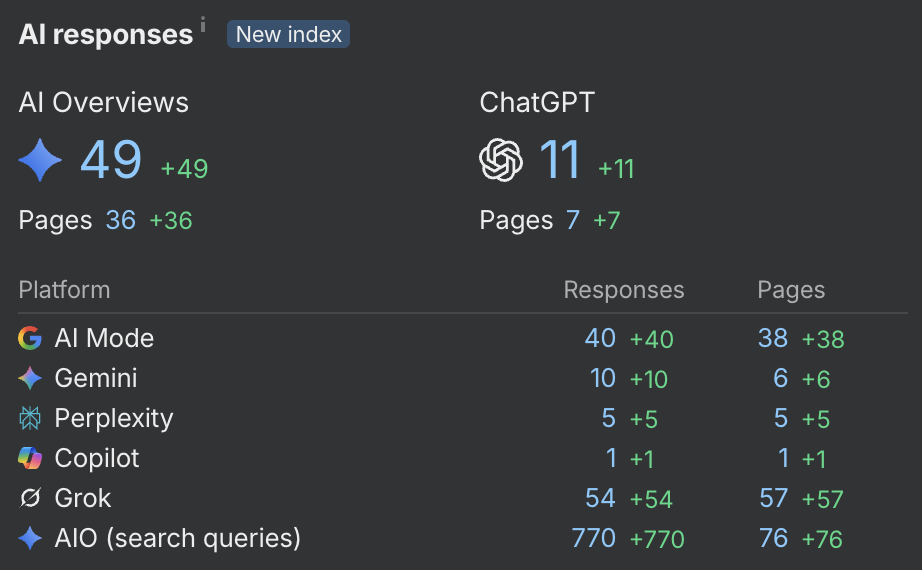
We already showed up in 49 Google AI Overviews, pulled from 36 different pages on our site. ChatGPT pulled from our pages 11 times, Grok did 54 times, and Google AI Mode did 40 times. We also looked at Google AI Overviews specifically, across every search someone could type into that category. Our pages got pulled into 76 of those overviews, covering searches that add up to about 770 monthly searches combined.
Every single one of these numbers started at zero, since this is a brand new way we just started measuring. And here is the part worth sitting with. We did not write anything special to try to get picked up by ChatGPT or Google AI Overviews. We just kept building the same clear, deep, honest content we already talked about in this post, on a site that had already earned some trust. The AI tools found it on their own.
That is the real lesson here. The tools people use to search are changing fast. The work underneath has not changed at all. Build a site that is easy to understand, deep on your subject, and trusted by other real sites, and you show up everywhere people are asking questions today, not just in the classic search results.
The bottom line
SEO can make or break a business, but not because of one clever trick. It works because it forces you to build the things that actually matter no matter what channel you use. A site that is fast and easy to use. Content that truly answers what people are asking. A real, deep base of trust built over time. Keep doing that steadily, every day, every week, every month, for months before you see the payoff, and eventually the channel starts working for you instead of you working for it.
That is what six months of steady, unglamorous work looks like once it starts to pay off. Not magic. Just a strong base, built the right way, from the start.
Sources: SEO.com, How Long Does SEO Take?; Search Engine Land, How Long Does SEO Take to Work?; SeoProfy, SEO Statistics 2026; Demandsage, SEO Statistics 2026. Awesome ranking and traffic numbers pulled from Ahrefs, as of July 3, 2026, India market.